Best Active Recall Study Techniques: 9 Ways to Practice


Closing your notes can feel risky: what if you can’t remember anything? That’s the point of active recall. These active recall study techniques help you practice pulling answers from memory, then use mistakes to decide what to review next.
An analysis of 47 YouTube comments about active recall study techniques found that 55% mentioned closing the book and recalling.
1. Flashcards: Retrieve key terms, concepts, and equations
Flashcards prompt you to produce an answer before you see it. They work well for short facts, definitions, vocabulary, formulas, and distinctions you need to keep straight.

Write one question on the front and a focused answer on the back. For accounting, you might ask which accounts change in a transaction. For a language class, put a word on one side and its meaning on the other. Say or write your answer before turning the card. Then check it against your course material.
Flashcards can help you retrieve terms, concepts, and short pieces of information. Quizessa can make flashcards from your PDFs, lecture slides, notes, photos, or videos, so you can practice without writing every card by hand. Its explanations and performance-based practice can help you spot which ideas need another look.
Keep cards small. If a question needs a full essay, try a spoken explanation or a short-answer prompt instead.
2. Self-Generated Exam Questions: Test yourself before and after studying
Writing your own questions turns course notes into a small practice test. It also lets you check what you know before studying a new section, not only after you finish it.

Before reading a chapter, scan its headings and make a few questions. Try answering from memory, even if you’re unsure. Then study the section and answer those questions again. The act of trying to retrieve information can make you more likely to retain it.
Make questions that ask for a reason or an application, not only a definition. For example, ask, “Which statistical test fits this kind of data, and why?” After answering, check the relevant slide or assigned reading. Quizessa turns uploaded course materials into MCQs, flashcards, and answer explanations, then adapts practice to your performance. Missed topics can guide what you review next.
For a more detailed routine, see five steps for practicing active recall.
3. Lecture Recall: Rebuild the lecture from memory
Lecture recall means closing your slides or notes and rebuilding the main ideas from memory. It suits material with a clear sequence, such as a history argument, a biology process, or the stages in a business model.

After class or after reviewing one lecture section, put the source away. On a blank page, write the key points you remember. You can also explain them out loud. Start with the central idea, then add examples or details that support it. Don’t worry about making the page neat.
Now compare your recall with the lecture slides. Mark a missing point or a link you got wrong, then check that part of the source. Try recalling the topic again later, rather than copying the whole slide deck. This is a more direct test than rereading because you have to generate the ideas yourself.
Use the format that fits the course task. If an exam asks you to write an essay, practice writing. If you’ll need to explain a process aloud, practice speaking. You can find more retrieval practice examples for different subjects when a blank page feels too open-ended.
4. Short-Answer Quizzes and Mock Exams: Practice producing complete answers
Short-answer quizzes make you produce an answer without a list of choices to guide you. Mock exams add the structure and timing of a test. Use both when your course expects you to explain, solve, or apply ideas.

Match practice questions to the exam format. If your instructor uses short answers, practice writing short answers. If the exam is multiple choice, practice choosing an option and explaining why it fits. For a longer mock exam, use course practice questions or questions you’ve made from your notes. Close your materials while answering.
After the attempt, check each answer against an answer key or the relevant course source. Mark the reason for a miss: forgotten detail, mixed-up terms, or a step you couldn’t apply. That note tells you what to review; a score by itself may not.
Short-answer quizzes can promote better knowledge retention than multiple-choice questions. Retrieval practice takes more mental effort than passively reviewing information. That doesn’t mean you should ignore MCQs. Use them when they match your exam, and add some open-response practice when you need to produce a full explanation.
Save strict timing for later practice. Early quizzes can be short and low-stakes while you’re still learning the material.
5. Teaching a Friend: Explain a topic in plain language
Teaching asks you to bring ideas to mind and put them into words. It’s useful for theory-heavy classes, linked processes, and topics where knowing a term isn’t enough.

Choose one small topic. Explain it to a friend, a study partner, or an empty chair without looking at your notes. Use plain language. In a contract law class, for instance, describe how two related terms differ, then give a simple example. In a science course, explain what changes at each stage of a process.
Turn your notes into a practice exam
Upload a document and Quizessa builds questions, flashcards and explanations in minutes.
Try it freeWhen you get stuck, pause and name the gap. Check the assigned source, then explain that part again without reading it aloud. A listener can ask “why?” or “what happens next?” Those questions can reveal a missing link in your explanation.
You don’t need to teach a whole chapter in one go. One clear idea is enough for a useful round of recall. And if no one is free to listen, speak through the explanation on your own or write it down.
6. Written Self-Explanation: Show how and why an answer works
Written self-explanation is a short account of how you reached an answer. It helps when you need to show your reasoning, not just recall a fact.

Close the source and write a few sentences in your own words. In statistics, explain why a method fits the problem. In accounting, show which rule supports a calculation. In history, connect a cause to an outcome. Add the key steps that would let someone else follow your answer.
Then check your explanation against the lecture slides, textbook, or official study guide. Look for a missing condition or a step that doesn’t follow. Rewrite only the part that needs fixing, then try to explain it again without looking.
Keep the prompt focused. “Explain the whole unit” is hard to check. “Why does this formula apply to this problem?” gives you a clear task. This method pairs well with flashcards: use a card for a term, then write an explanation when the idea needs more depth.
7. Mind Maps: Recall how ideas connect
A mind map tests whether you can recall links between ideas, not just separate facts. It’s a good fit for a lecture with themes, causes, examples, or related concepts.
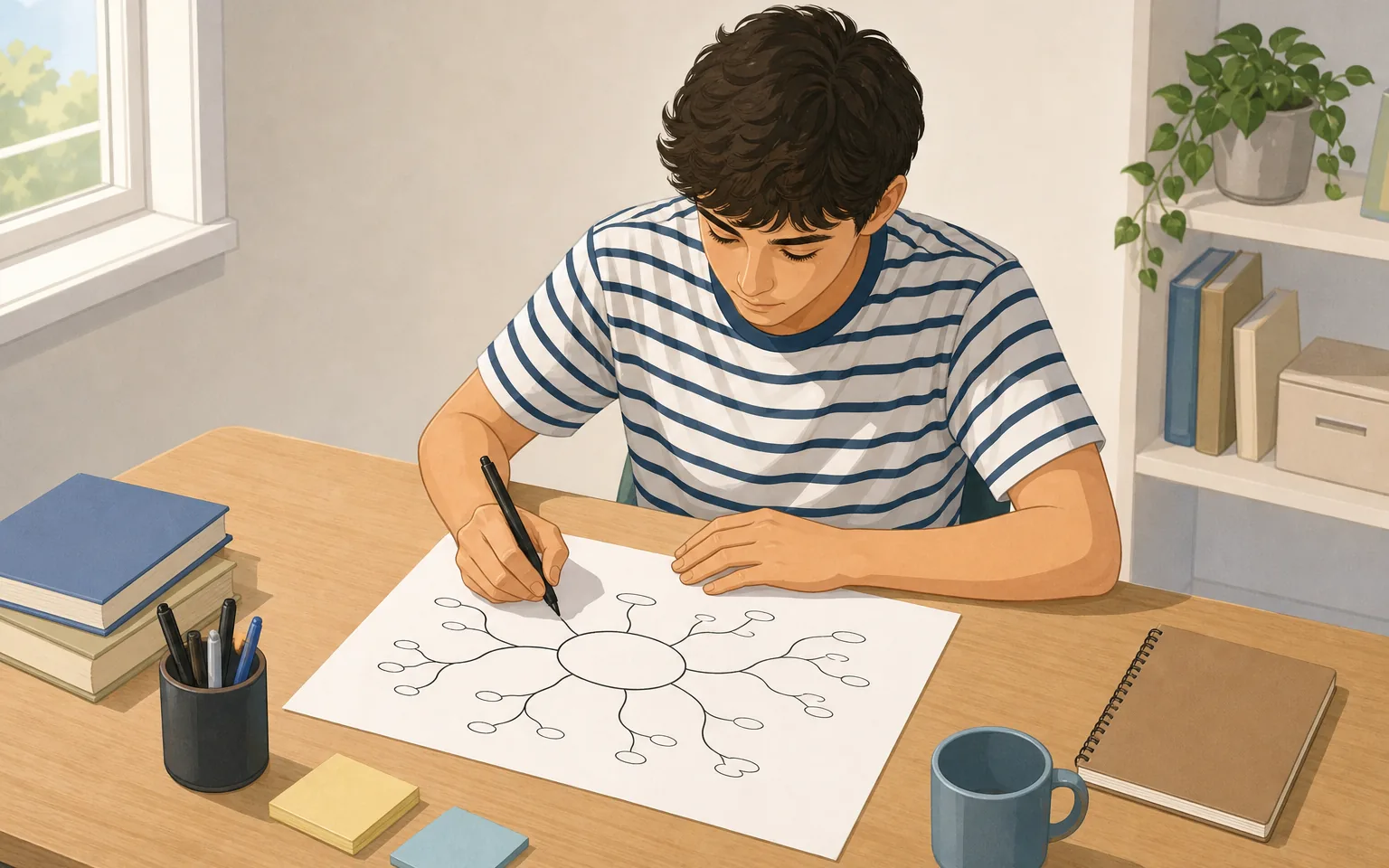
Write the main topic in the center of a blank page. Without checking your notes, add the ideas you remember around it. Draw lines to show how each point connects. For a business lecture, you might link a decision to its costs and likely effects. For a history unit, connect events to causes and outcomes.
Once the map is down, compare it with your course material. Add missing links in another color. If two ideas belong together but you couldn’t explain how, make a question about that connection for your next review.
Mind maps can help you organize and connect material, but they don’t replace checking whether you can explain it. Try making the map from memory first. If you’re stuck, a quick glance at your notes can help you learn the structure, but close them before you test yourself again.
When the basic ideas feel familiar, mix questions from more than one topic. Switching between related topics can make you choose which idea fits, rather than relying on the chapter order as a clue.
8. Drawing and Visualizing: Recreate diagrams, processes, and timelines
Drawing from memory is useful when the material has a shape or order you need to reproduce. That could be an anatomy diagram, an engineering system, a language structure, or a timeline of events.
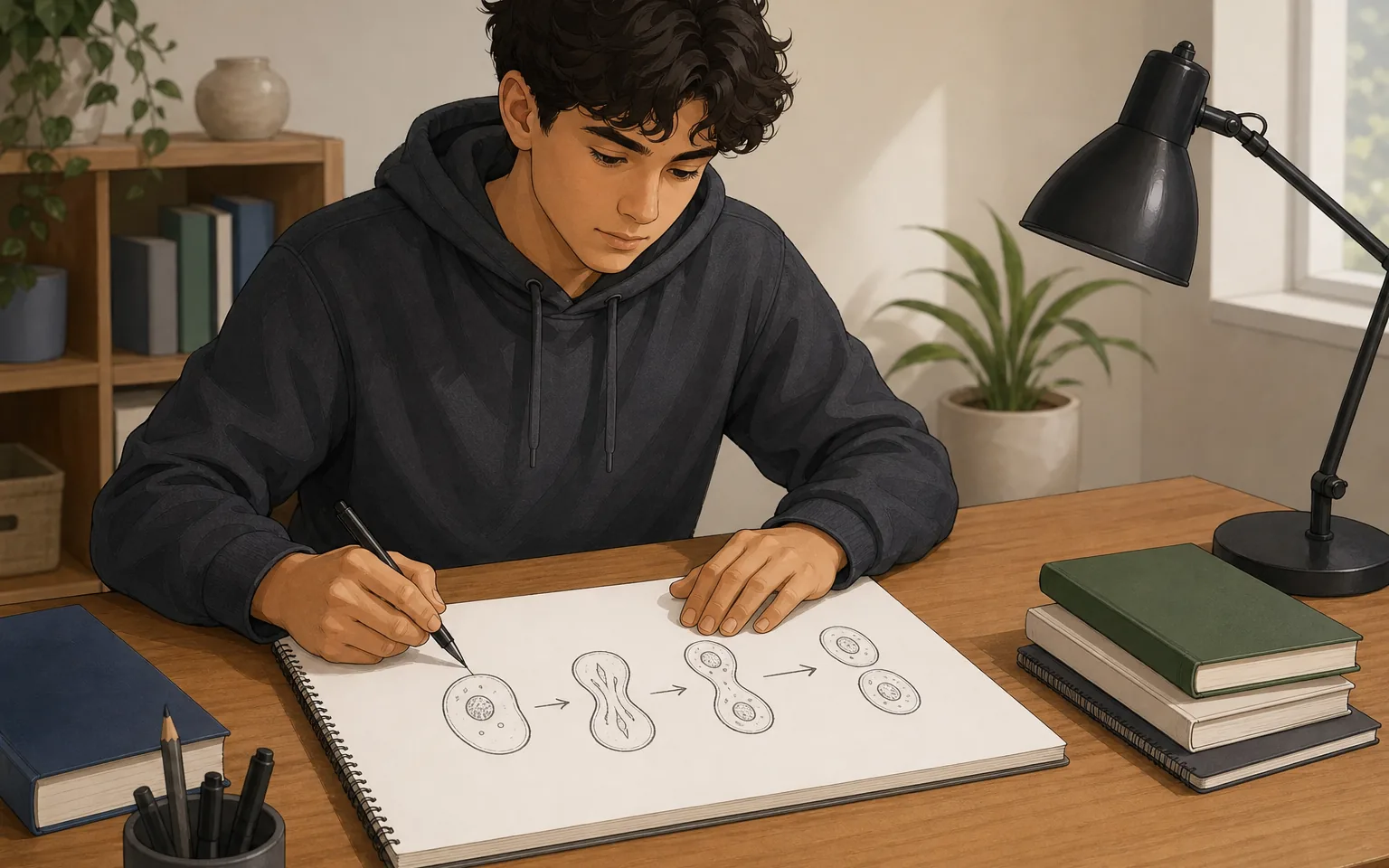
Start with a blank page. Sketch the parts you remember and label them from memory. For a process, show the order of events with arrows. For a timeline, place major events in sequence and add a brief note about why each one matters. Don’t aim for art. Aim for a drawing you can check.
Then compare it with your course source. Add missing labels or steps in a different color. If a structure is hard to remember, cover the diagram and redraw just that part later. Quizessa can make practice from uploaded course materials, which can help when a class’s slides contain diagrams alongside written notes.
Keep the source close for checking, not for copying. The recall happens while the diagram is hidden.
9. Mnemonics and a Recall Log: Memorize details and track what to revisit
Mnemonics give a set of details a memorable cue. A recall log records what you could retrieve and what needs another pass. Use the cue to remember the information, then use the log to plan when to test yourself again.

“Please Excuse My Dear Aunt Sally” is a familiar mnemonic for the order of operations in math. It can help bring the sequence to mind, but you still need to practice applying the rules to problems. A mnemonic is a memory cue, not a substitute for understanding the topic.
After a study session, jot down the topic, how your recall went, the detail you missed, and a date to try again. You can keep this in a notebook or a spreadsheet. If you recalled the idea clearly, leave a longer gap. If you missed a key point, check the source and return to it sooner. There isn’t one review interval that suits every class or exam date.
| What you noticed | What to do next |
|---|---|
| Couldn’t recall the key idea | Check the course source, then try the same prompt again later |
| Got the main idea but missed a detail | Record the missing detail and revisit the topic soon |
| Explained it clearly from memory | Set a later review and include it in mixed practice |
Quizessa tracks topic mastery and a Readiness Score to help you decide what to review. Treat those as study signals, not guarantees about an exam result.
Frequently Asked Questions
What is active recall in studying?
Active recall means trying to bring information to mind before looking at the answer. You might answer a flashcard, explain a lecture idea from memory, or redraw a diagram with your notes closed. Then check your response against a trusted course source. That check helps you spot gaps and correct mistakes.
How often should I use active recall?
Use it during study sessions, then return to the same material after time has passed. A simple starting point is to review the next day, then again after a few days, and later in the week. Adjust based on your exam date and your results. If you miss a key idea, revisit it sooner.
Is active recall better than rereading?
Active recall is a stronger choice when you need to produce an answer without seeing it first. Rereading can help you take in new material, but familiar words on a page don’t prove you can retrieve the idea. Read a short section, close it, try to recall the main points, then check what you missed.
Can I use active recall before learning a topic?
Yes. A short pre-test can show what you already know and give you questions to look for while studying. Don’t worry if you get some answers wrong. After reading the relevant material, check the correct answer and try the prompt again. Keep the pre-test low-stakes and focused on the topic you’re about to study.
How can I make questions from lecture slides or PDFs?
Turn a slide heading or key point into a question that asks for an answer, reason, or application. Check each answer against the original material. Quizessa can generate MCQs, flashcards, and answer explanations from uploaded course materials, then adapt practice to your performance. Review generated content against your class source, especially for details your instructor may test closely.
Conclusion
Pick a technique that matches the exam task: use cards for short facts, explanations for linked ideas, and mock exams for timed practice. Start with one lecture or PDF, try a closed-note recall session, and use the gaps you find to choose your next review. Quizessa can turn your own course material into practice when you want help getting started.
Turn your notes into a practice exam
Upload a document and Quizessa builds questions, flashcards and explanations in minutes.
Try it freeRelated articles
-
Best Active Recall Flashcards: 5 Tools for Students
Active recall flashcards make you pull an answer from memory instead of rereading it. The right tool can turn your course material into focused practice, then help you return to the topics you miss...
-
Best Spaced Repetition Flashcards: 6 Tools Compared
Spaced repetition flashcards bring facts back after a gap, so you have to recall them instead of only rereading them. The hard part is finding a tool that fits your material and leaves enough time...
-
Best Apps for Studying: 6 Picks for Your Courses
The best apps for studying should help you do more than sort your notes. If your course material is spread across PDFs and lecture slides, the right tool can turn it into practice you can use. Here...